
According to the location pin I was sent on WhatsApp, I am in the right place. The message said that the “facility’s name is not very visible”, which is evidenced by the complete lack of signage above the door. After some hesitant knocking, I am ushered in by a security guard who locks the door behind me and checks me for weapons before asking why I am here.
A week later, I am in the lobby of a private hospital. I’ve been assured that they offer abortion services, but again, there is no visual clue that this is the case. I sheepishly ask a security guard if she knows where I should go. She holds up seven fingers and points to the elevators. Inside, “Parking” is written next to the Level 7 button. I press it anyway, feeling like I am in the wrong place and doing the wrong thing.
I work for Gender Rights in Tech (GRIT), helping to develop an AI chatbot to support abortion access in South Africa. I was grateful that I was just visiting these sites as a researcher. I cannot imagine having to navigate this clinical cloak-and-dagger as someone needing an abortion at that moment. I was surprised to see that even the hospital linked to a world-famous abortion provider was reluctant to clearly signpost where to go for termination of pregnancy.
South Africa is supposed to be ‘progressive’ when it comes to abortion.
The confusion I faced navigating these clinics is even more damning considering the context. I’d recently been told by a Kenyan colleague that our country is used as a positive case study in their trainings. We boast one of the more progressive and permissive abortion laws in the region. Abortion is legal on request up to 13 weeks, and in various circumstances up to and beyond 20 weeks.
The Choice on Termination of Pregnancy Act (CTOP) was the result of efforts by feminist activists during South Africa’s transition from apartheid to democracy. According to parliamentary debates at the time, the apartheid-era law didn’t fit the ideologies of the ‘new’ South Africa because of “the issue of access”. Those advocating for the CTOP Act (brought in in 1997) argued that, during apartheid, the “majority of women who manage to procure legal [or illegal but safer] abortions are white…women who present themselves at hospitals with septic abortions are black”.
The new Act was explicitly designed to broaden access to safe abortion and to make it more equitable compared to the racist apartheid past. With this context in mind, how was I to interpret my struggles to access abortion services as a researcher 30 years after this law was passed?
404: Abortion Services Not Found
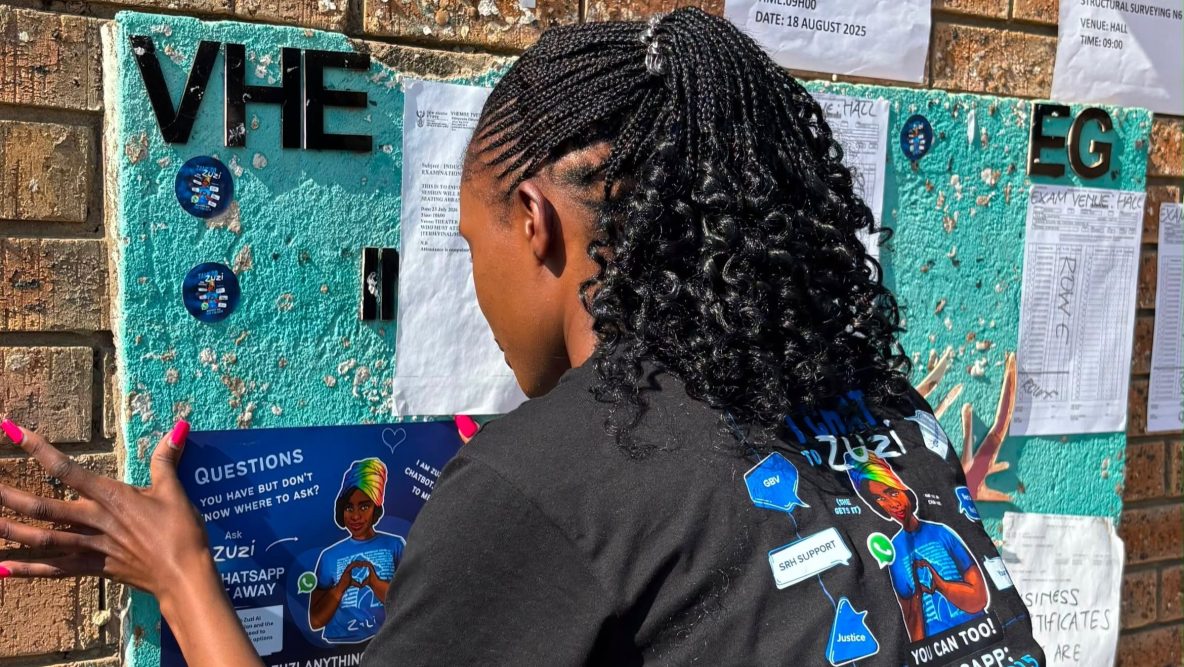
At GRIT we have already developed a generative AI chatbot called Zuzi. Zuzi provides information about gender-based violence and sexual and reproductive health and rights. With the support of SAAF, we have been conducting research into abortion access in South Africa so that the chatbot can be trained on a dataset that provides detailed, accurate, and localised information on accessing safe abortion options.
Initially the idea was to augment existing services by providing accessible information in local languages that we expected to be readily available on governmental websites or offered by healthcare providers. The missing signage above the door, it turns out, is mirrored online too.
Our research has revealed that online information about abortion services is outdated and somehow manages to be oversimplified and overly technical at the same time.
Abortion remains markedly inaccessible in South Africa despite our liberal law. We have spoken with abortion seekers, experts, activists, providers, and academics who all tell us that termination of pregnancy services are marred by anti-abortion sentiment, limited capacity, and inconsistent implementation. And these barriers disproportionately affect the same women who were disadvantaged under the apartheid regime. The same women who the new law was supposed to support.
On Bots and Barriers to Access
In doing the research to populate the dataset for our chatbot, we have learned about the dire state of access to safe abortion for those needing the service. Conversations with Zuzi highlight how under-capacitated and unavailable abortion-related care is in South Africa. We have been confronted by stories of people who cannot access a legal or safe abortion in their small, rural town because those in charge of healthcare services are anti-choice.
In this kind of landscape, tools like Zuzi can act as a helpful stopgap.
Users of the tool are asking how to respond to refusals, whether abortion is even legal, and how they could be expected to ‘prove’ they are deserving of care (especially in the second trimester). We dream that one day, Zuzi can be part of a shift in people’s relationship to the institutions that gatekeep access.
Chatbots like Zuzi are no replacement for stigma-free, accessible human care or expertise. Those dictating the pace of AI development are also unabashedly aligned with the anti-rights movement. It’s important to ask the uncomfortable questions about law, access, AI, and abortion. If we envision a world where people feel confident asking AI tools like Zuzi what they can’t ask anyone else, it is critical that those people are co-creating the technology.
We are working with women and others who may need abortion services, co-creating the chatbot with those who have historically been excluded from tech design. This includes sex workers, rural communities across the country, young people in underserved schools, and Deaf GBV first responders.
The CTOP Act wrote access into law thirty years ago; the least we can do is find creative ways to help people find the door to the services that they have a right to access.
By Ronel Koekemoer, Head of Safeguarding and Survivor-Centred Programmes at GRIT, a SAAF grantee partner in South Africa.