
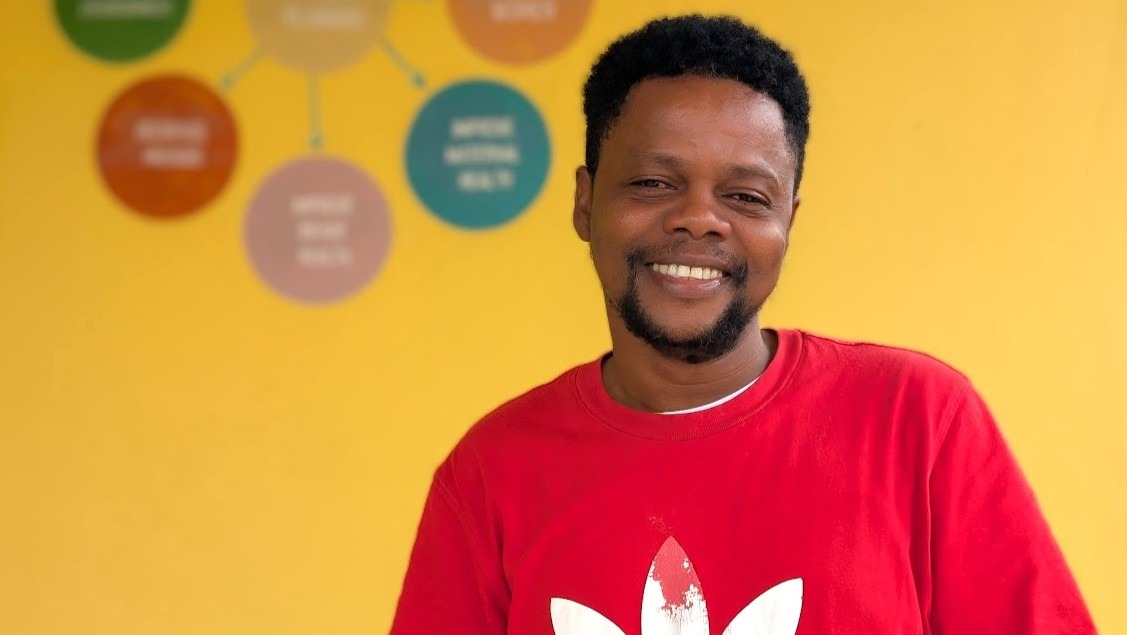
My name is Ramses Hodges and I serve as Project Manager with Community Healthcare Initiative (CHI).
I believe in gender equality. I think that it has been an issue within the country where we see that men have always been in the position to make key decisions and leave women out. This is patriarchal and I think this is a system that we need to dismantle to ensure that men see women as partners in terms of decision making.
When I grew up I saw that equality between the sexes was possible as my father always involved my mother in decision making. My father is kind, very quiet and they are a lovely couple who believe in sharing and responding to each other. Then I see in society where we have positioned men and women in particular roles. They say, ‘This is what you should do as a man, and this is what you should do as a woman’. I think this creates a huge gap in terms of gender equality, because if you assign strict roles and responsibilities, you’re creating the gap, when in fact men and women can do the same things.
Women should be able to decide if they want to bear a child or not.
Choosing to have an abortion is women’s reproductive right. They should decide whether they should carry the child or not. That shouldn’t be an issue. When a woman decides that she doesn’t want to be pregnant and there are barriers to access she tends to find a way to end this pregnancy in secret. These ways of doing abortion are not safe and can cause serious health problems.
As a result of our constant engagement with the community I can proudly say that there has been a shift in attitudes to abortion. Some people at the community level believe that culture prohibits certain practices but following our engagement we have changed the paradigm. People now tend to respect other people for who they are. People now see that there’s something called human rights that benefits us all.
We have a group that promotes healthy masculinity among boys and girls where we talk about reproductive health and sexual rights and how boys can support women as partners. Most of the time, people tend to want to focus on women too much and leave out the perpetrator. But we have now seen examples of people in groups saying ‘I used to beat up my girlfriend but I’m no longer going to do it’. Some people make a personal commitment that they are not going to do this again. We are seeing a change in the community and people are saying it is the need to respect other people for who they are.
I am very proud of the holistic work we do.
I have one particular experience of working with a community where there were high levels of violence. Through our engagement we were able to set up different community structures by working with the leadership, working with the youth, and with women’s groups. We were able to change things.
We have a holistic approach because we have legal practitioners, psycho-social support and SRHR experts on board. We set up support groups for survivors of gender based violence and those that had experienced traditional practices such as early marriage and female genital mutilation. When people started to share stories it was tough, but listening to the victims and helping to provide support has been something very integral to the work we do. Because of our trauma informed survivor-centred approach we have seen the immense successes coming out of here. Women who have experienced violence and coercion are now seeking help when needed and are not afraid of being stigmatised. Following this engagement people are now telling us that they are happy and I’m so proud that they’ve been part of this particular project because we can see the change.
I feel proud to know that I am making a difference. I am very passionate and proud of the work that I do.
Interview with Ramses Hodges – Project Manager with Community Healthcare Initiative (CHI), a SAAF grantee partner in Liberia.