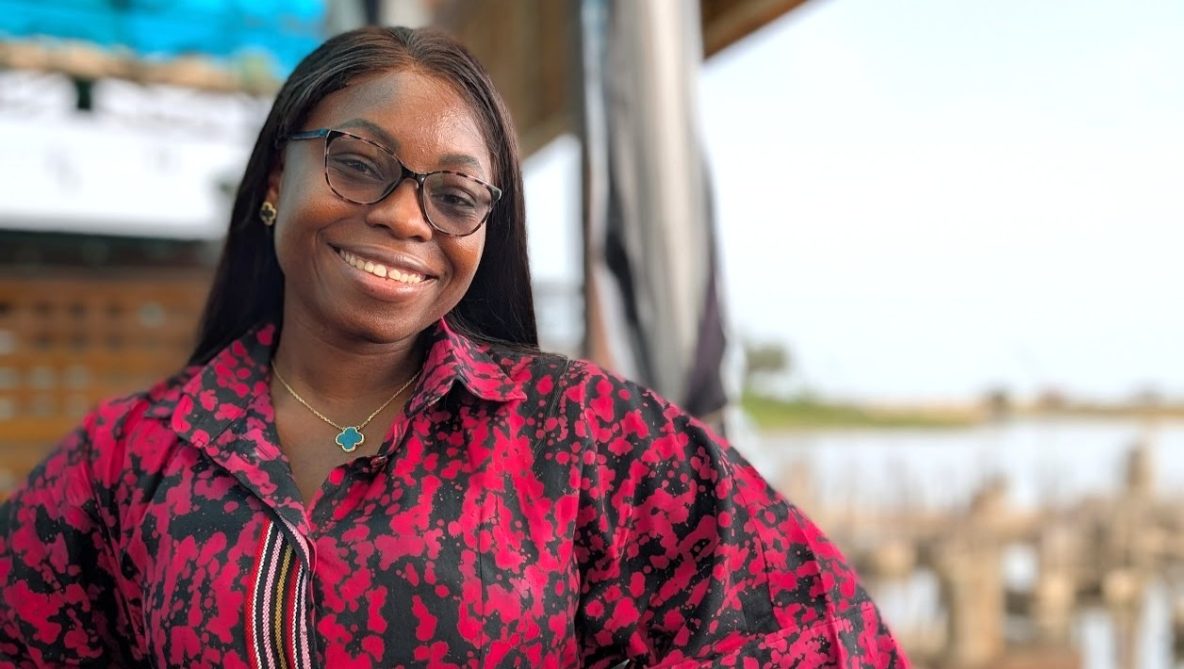
My name is Naomi Tulay Solanke. I’m the founder and Executive Director of Community Healthcare Initiative (CHI), which was founded in 2013 and became registered in 2014.
I was working as an Emergency Room nurse at a hospital in Liberia and seeing so many teenagers walking in with unwanted pregnancies. They were named, shamed and blamed, and told that they should have considered what would happen if they had sex. They were told that they had to keep the pregnancy and were not offered an alternative by the hospital. But most of these girls were either raped or coerced. The hospital couldn’t provide the alternative they were looking for. Seeing this spoke to my own experience as a very young mother who was faced with the same circumstances after becoming pregnant at the age of 14.
So I had the idea to go into the community and provide awareness around preventing pregnancy. And then I realised that you can talk about preventing pregnancy and also provide alternative care to those who have unwanted pregnancies, because abortion is a right and is permitted in certain circumstances in Liberia.
I think people should have the right to make an informed decision about their body and about their life.
When we started the work in the community, we realised that you can talk about preventing pregnancy but there are people who are already pregnant and don’t want to be. How do we address those people’s needs? We were looking for support and saw the SAAF call for funding. I thought that this could help us to manage the issue of those who want to access services that are not afforded to them.
Carrying a pregnancy is one thing, caring for a baby is a whole other issue. If the mindset and necessary resources are not there it can lead to negative consequences. Sometimes, babies are discarded, there is post-partum psychosis because the mother isn’t ready. You can prevent all that with access to safe abortion services.
It used to be hard to talk about abortion. It’s not as hard these days.
Now we can have the conversation about abortion. We can have a conversation about choice. We can have conversations about rights and it’s easier than before. It is easier in those communities that we have worked with consistently. Whenever we go into a new community, we have to start over with what we learnt from the other communities.
Abortion stigma used to manifest around the idea of promiscuity. It was believed that only women who did not know who the father was used to seek abortion. They used to say that women who seek abortion are killers. Now it has shifted, and people see abortion as something for people who have a vision, people who have ideas about what they want to do with their life. They’re not ready. They don’t want to have a baby right now.
The law on abortion in Liberia is restrictive but there is still space for access.
The law allows for abortion in cases of rape, incest, deformity, and risks to the woman’s life or health. We are campaigning to remove the restrictions to abortion in the law. We are pushing for abortion to be included as healthcare in a clean, safe environment. We want to take out the requirement for two physicians that need to sign for approval as this is not practical in Liberia. We are also pushing for the gestational limit for legal access to abortion services to be up to 20 weeks.
A lot of people want to access the service, but they cannot afford to travel to our centres, so we use mobile clinics that go into the community and provide contraceptive services. We also provide abortion care from the mobile clinics depending on gestational age. We can provide the medication or in later gestations refer for services at our clinic or at the hospital. If someone comes with symptoms of an STI we refer them to our clinics so that they can get tested and then treated.
We work with community leaders and have seen a noticeable change in the way that they talk about women’s choices.
They might not say abortion, especially a religious leader, but they talk about how women should have a choice to have children. We feel this is a positive step, as their community listens to them, and when they start to talk about choice, we also talk about choice and it amplifies the work that we do.
We are seeing an increase in external opposition in Liberia. We are resisting the so-called “family values conference” (funded by US organisations). We understand what African family values look like and we don’t want to be taught it. We figure that it’s colonisation in another form. So, for anybody who thinks that in 2026, they’re going to teach us, especially Liberian women, that this is what our family values look like, we resist it. We are resisting the opposition that is coming from outside, trying to control our bodies, because we know that it’s a trick.
I do this because I believe in hope, I believe in collective work.
I do this because the women and girls of this world, especially Liberia, deserve better and if we sit down and don’t do anything, we are as bad as the people who are harming them, so we need to stand up.
I am very proud of my work. When a young woman comes to my office, her eyes full of tears, feeling hopeless, I am able to tell her that even if she doesn’t have any resources we can provide her with the services she needs free of charge. We are able to cater to people who are so desperate – sometimes I see them leaving after the service and I’m so proud – that is success for me.
Going into a community where once we couldn’t even talk about contraceptives, but now, we’re talking about safe abortion. And you see women leading the conversation about our bodies, our rights, how we should have access to abortion services, that makes me so proud.
I think the way we have shifted power in the community should be celebrated.
Knowledge is so powerful. These women can now demand for the legislation to change, they know what they need. They understand abuse, when they see it, they know they can call us.
I am particularly proud of one case where we had two students who were graduating from high school, and they had both just found out that they were pregnant. They were so in fear of their parents, their community, their church. During one of our outreaches in the school, the first one came to me, to say ‘I need to talk to you. I need your number.’ So, I gave up my number and she called me in the night, and she said, this is my problem but I’m not alone – I also have a friend who is pregnant. We were able to support them and help them. They both graduated and are in college and are now some of the activists who talk about abortion rights with us. Each time I see them on the podium I get tears in my eyes as they tell the story that because of us, they are able to be educated and now they can make informed decisions around their lives. That is one of my proudest moments.
Interview with Naomi Tulay Solanke – founder and executive director for Community Healthcare Initiative (CHI), a SAAF grantee partner in Liberia.