
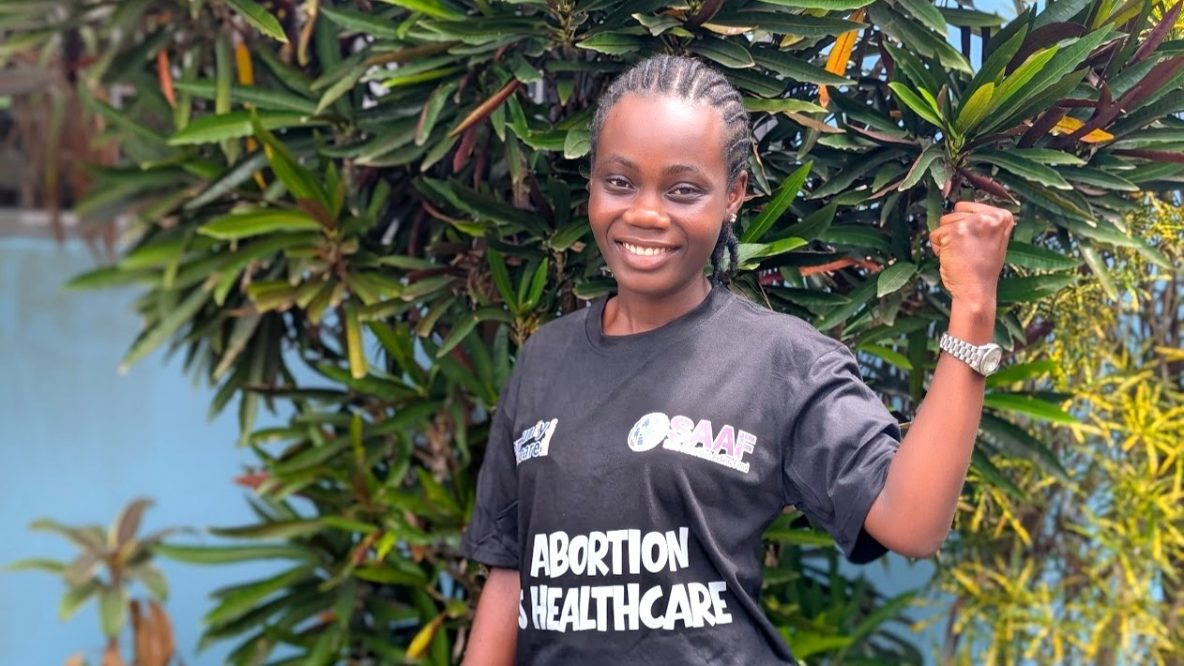
My name is Musulyn Johnson. I’m a field officer at Community Healthcare Initiative (CHI) and work with young people in the community.
When I was 19, I got involved with one of CHI’s projects focussed on youth leadership. I have always had this passion for social work, especially coming from a community where, as a young woman, you’re not supposed to do this, or not supposed to do that. So, I got interested in working with other young people on their sexual and reproductive health and rights (SRHR) and also female leadership.
CHI is particularly intentional when it comes to working with young people. So, it’s not just working with young people and leaving them. We don’t just have a working relationship with the young people, but we see them as sisters. Most of the young people I work with are my own age. Once you have your peers speaking to you, you’re more open because I feel like, what I am experiencing is the same thing that you may be experiencing.
I had a friend who died from an unsafe abortion.
Unsafe abortion is a major issue here and by restricting abortion you don’t stop it, you just make it unsafe.
A lot of young people don’t know how to access safe abortion and are afraid of having to tell their parents, so they seek unsafe abortion, which some people call ‘RPG’. They gave it that name because RPGs are terrible weapons (it stands for rocket propelled grenade). That was what that girl used, and she died. So, I always argue that people should have access to safe abortion because a lot of young people have died as a result of not having access to safe abortion.
It can be tricky to talk about abortion depending on the community but a lot of young people are more open to the conversation these days. So, the main issue is to tackle the parents’ acceptance as some of them are religious and won’t let us talk to their children about this. We have to help the parents understand that it’s not us telling their daughters to have abortions, it’s simply about giving them the information they need not to get trapped. There are still a lot of myths, some spread by older generations – such as the idea that once a girl starts her period it is up to God if she gets pregnant just if someone touches her. We need to clarify with factual information about periods and reproductive health.
It’s about young people having more information, more knowledge and knowing their bodies.
These conversations can limit the amount of unsafe abortions we have in the community. We have built relationships with young people that mean they can easily reach out and come to our office if they have any problems and we can see how we can help them.
I feel like we should all work together and legalise safe abortion across Africa as people die from unsafe abortion and pregnancy can’t always be prevented, especially in cases of rape. If you force someone to continue a pregnancy you can cause more trauma.
In the past, such as when my mother was young, people wouldn’t openly share their experiences in public but now, we do. I feel like we are more progressive. I think a lot of Liberian youth in a few years’ time will be able to stand up for themselves.
I want to encourage other partners working in this field to invest more in SRHR and sexuality education in schools as we should all have the right to do things with our bodies. Let us be informed about things that affect us and not just be kept in the dark. We need to shift that perspective.
Interview with Musulyn Johnson – Field Officer at Community Healthcare Initiative (CHI), a SAAF grantee partner in Liberia.