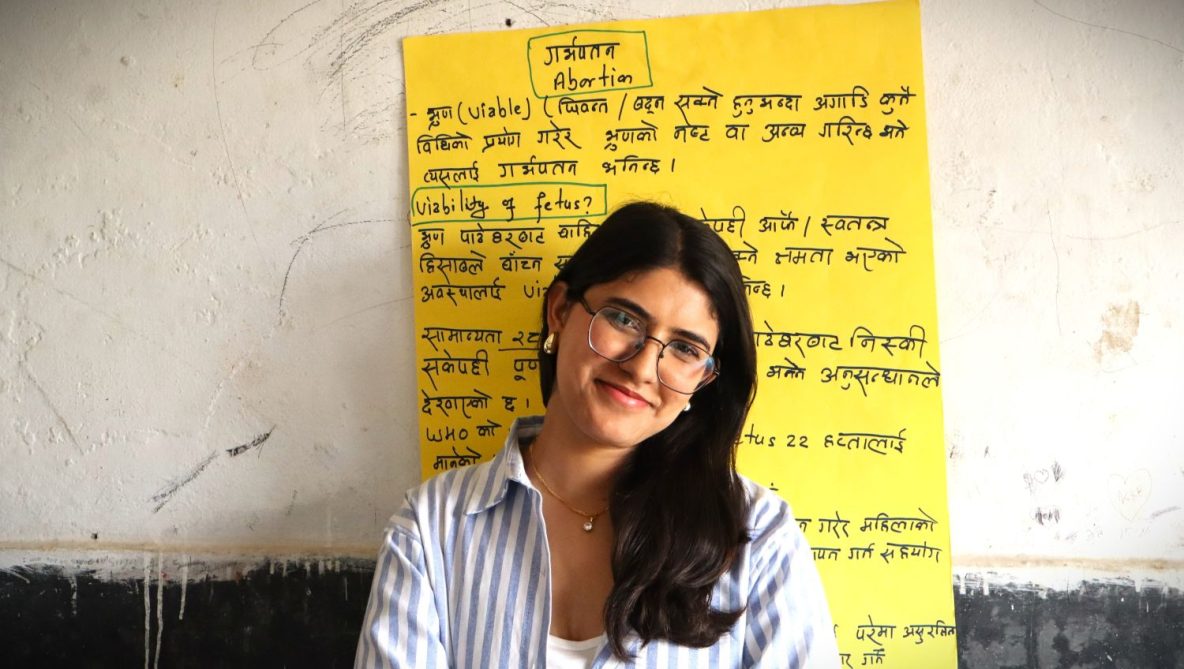
I’ve been Senior Programme Officer at Visible Impact for three years, but I first joined as a menstrual health advocate. When I came for the training, I really liked the office environment and saw that the team was so friendly, like a family.
Today I lead on two projects: the SAAF-funded Youth for Access to Abortion for Youths (YAAY) and No Shame to Bleed, which focuses on menstrual health. I’ve been interested in these kinds of issues since childhood but didn’t always realise when I was advocating for my rights.
We can’t even discuss menstruation in my community.
I belong to a family where patriarchal norms are deep-rooted. Growing up as a girl is very difficult.
When I got my first period, my parents told me I have to be in a closed room with no access to sunlight and that I can’t look at my brother or father. People say that a girl who has her first period shouldn’t even look at a man, they think it will limit his life expectancy.
My older sister had done this before me, but when it came for me to be in that dark room, I fought with my parents to go back to school. I cried a lot, and they reduced the number of days to four days. There was not even access to sanitary pads; I had to use cloth pads, but I didn’t even know how.
Later, when I studied public health, I realised I could advocate for these issues in a much more focused way. That’s when I realised how passionate I was. Because if I had just accepted what my parents told me, things would never have changed.
To this day I still want to keep fighting. I don’t want other girls to go through that – I want them to have information and know what to do.
So, when it comes to SRHR I have always fought for it, even when I didn’t know I was doing this.
I had heard the term abortion but never really understood it.
We did have some education at school about menstruation and reproduction, but my teachers would just read the textbook line by line or skip it entirely. All the information is written in English but then explained in Nepali, so we didn’t even understand all the meanings of the words. Students would laugh, the boys would tease the girls, it was very hard to open up and ask questions.
So now, whenever I lead sessions on SRHR with young people, I make sure to cover even the most basic information about how our bodies work. I never want young people to leave with the same confusion I had.
I had only heard people whispering about abortion in the community; it was always a very private conversation. It was only when I did a bachelor’s in public health that I came to learn about the Safe Motherhood Act and that abortion is a basic right.
During my internship at Visible Impact, I attended a VCAT training and learned a lot more. There was a video which showed how a woman had died from unsafe abortion. I cried my eyes out because of that story; I was shocked to learn that this is still happening. It’s something we need to talk about openly.
The government asked us to help ensure more providers were trained on abortion care.
Through our advocacy, we managed to make connections with local government departments. We found many people couldn’t access abortion because there weren’t enough trained providers and many health facilities hadn’t been officially registered to provide services.
We now support healthcare workers to complete the government training needed to become licensed abortion providers, making it possible for them to train close to home.
In the two provinces where this training is being provided, we have seen a total of 35 trained, and 22 providers already listed and providing services.
More trained providers and more registered health centres mean people – especially those in rural areas – can access free abortion care much closer to home.
I have become someone who can educate other young people.
I have become so confident since joining Visible Impact. I feel like I’ve grown from being a person who had no knowledge about SRHR to being someone who now advocates with her whole heart.
There is still not much space given for young people to talk in society; their knowledge is not trusted. I want to change that and make sure young people can take a stand to really intervene in spaces which relate to their rights. I love getting to see their journey – how they now confidently advocate for the issues they care about, and how this helps them in their lives and future careers.
I want Nepal to be a place where no one hesitates to seek healthcare because they fear judgement. People should be able to ask questions, get accurate information, and access safe abortion without shame.
Interview with Manita Sharma, Senior Programme Officer at Visible Impact, a SAAF grantee partner in Nepal.