
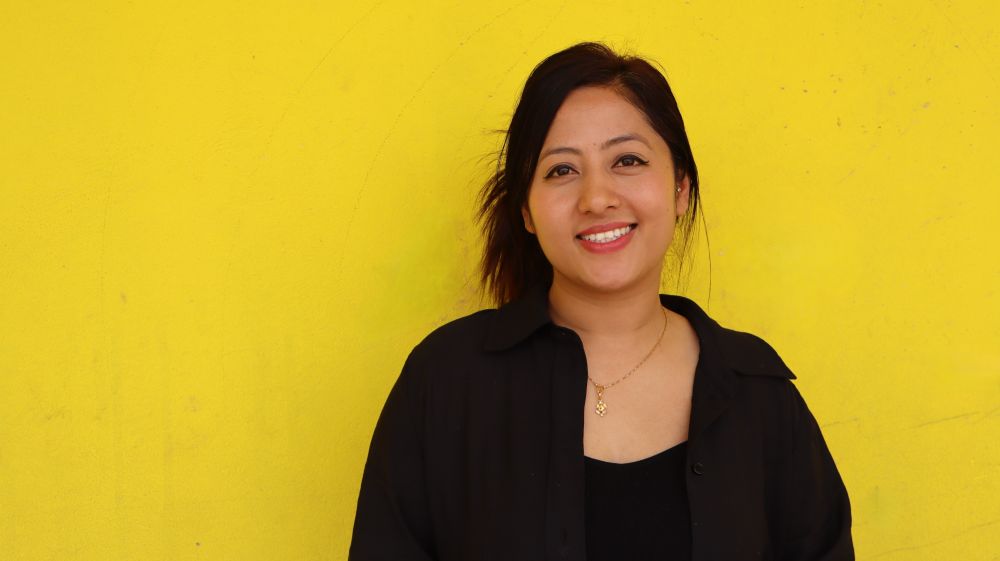
I first joined the Visible Impact team in 2017 as a volunteer, working as a menstrual health advocate. From there I took on a range of roles before becoming Executive Director in 2024. When I joined the organisation, it was just me and our founder, Medha Sharma. Today we’re a team of 17! Medha noticed that in Nepal young people tended to be treated mainly as beneficiaries rather than as leaders and decision-makers. She wanted to ensure young people’s voices were really heard through meaningful youth participation.
Young people are the largest group in Nepal, and finally we are seeing more young people come through as parliamentarians to represent our issues. And our new Prime Minister, just 35 when he was appointed, is currently the youngest in the world.
Young people have been fighting against the corruption of the government.
Before the election in March this year, we saw huge protests in Nepal. The youth movement wanted to see change – and after social media was banned, they took to the streets. The protests started out peaceful but eventually people were breaking into parliamentary buildings and police opened fire on young protesters. 19 young people were killed; it was so heartbreaking. We never thought the protests would take this turn – it was chaos, people were carrying guns, prisoners were escaping jails, it felt lawless.
Following the unrest, an interim prime minister was appointed to bring some order, and fair and peaceful elections were held earlier than planned. The subsequent election brought Balen into office who had already proven himself as mayor of the capital, Kathmandu, and young people voted for him as they were enthusiastic about the changes he had made there.
As young people, we hope to see less of the deep-rooted patriarchy of the past. There is now greater representation of women in the parliament. It’s still early, but we are hopeful.
Sexual and reproductive health is still taboo in Nepal.
Nepal is still a deeply patriarchal society. Sex before marriage is still stigmatised, this makes it hard to seek contraception and abortion. Young people are hit hardest. They have less money, less mobility, and less decision-making power because many still live with their families.
One of the biggest challenges is awareness. Only half of people know abortion is legal. They don’t know that they can get free and legal services from the government.
Part of our work with SAAF is empowering young people through intensive boot camp trainings. We bring together groups of young people for several days of intensive training and start from the very basics – anatomy and menstruation, contraception and abortion, the things they didn’t learn in school. They start to gain clarity and confidence and then go back into their communities to spread this information.
Media representations of abortion in Nepal are regressive.
We carried out media monitoring to see how abortion was represented in the news. Articles described abortion pills as though young people were getting hold of them “like sweets”, and it was portrayed as something negative which should be reduced. Articles were illustrated with images of scissors and full-term foetuses – visuals designed to frighten people rather than accurately represent abortion care.
So, we also trained media professionals and journalists from each province of the country. Eventually, having learned more about the realities of abortion, and with our support for research and travel, they started to write amazing pieces. We now also work with online influencers and content creators who have been creating videos with factual content on abortion. Some even went to health care centres to show people clearly the process of how to get a safe abortion service.
Abortion is a necessary healthcare service. When you need it, you need it.
We are part of the National Reproductive Health Rights working group and have submitted proposals for the law to be further liberalised. We hope the new parliament will create fresh momentum for reform.
Under the current law, abortion is not permitted after 28 weeks, even when the life of the pregnant person is at risk. We are still seeing cases filed against providers and women seeking abortions – the police don’t understand the law properly, so court proceedings have even been initiated. This gives the message that abortion is a crime until proven otherwise. We demand full decriminalisation.
Abortion is healthcare, not a criminal act.
Interview with Shilpa Lamichhane, Executive Director of Visible Impact, a SAAF grantee partner in Nepal.